The national high-school team coding championship Garage.run() Schools Cup 2027
One secret level. Three hours. No AI. Just your code.
One team per school, three students, one computer. For three hours they program a crew of mechanics in Python: share the tools, avoid deadlock, fix every car. The server is the judge: no luck, no outside help.
- Contest day
- Tue 16 Mar 2027
- Where
- An academic campus, to be announced
- Registration
- Opens 22 Nov 2026
- 8weeks of training first
- 3hours of contest
- 3secret stages
- 3hidden variants per stage
- 0AI, internet or phones
What is the Garage.run() Schools Cup?
The Garage.run() Schools Cup 2027 is a national team coding competition for high schools in Israel. Three students in grades 10–12 from each school write Python for three hours to solve a secret level of Garage.run(), a browser coding game about concurrency, with no AI and no internet. The contest is on Tue 16 Mar 2027, and registration opens on 22 Nov 2026.
Updated:
- What
- A team coding competition, in Python
- Who
- High schools, grades 10–12. One team per school: 3 contestants, a reserve and an accompanying teacher
- When
- Tue 16 Mar 2027, 08:30–15:30
- Where
- An academic campus, to be announced
- Format
- 3 hours, 3 secret stages, on a closed network, no AI and no internet
- Languages
- Code in Python; the game and every document in Hebrew, Arabic and English
- Price
- ₪3,068–₪3,894 per school. Parents pay nothing
- Registration
- Opens 22 Nov 2026; early price until 15 Dec 2026
- Practice
- Free levels in the browser, no account; 8 weeks of training included
- Organized by
- PyMaster
A repair shop where every mechanic is a thread
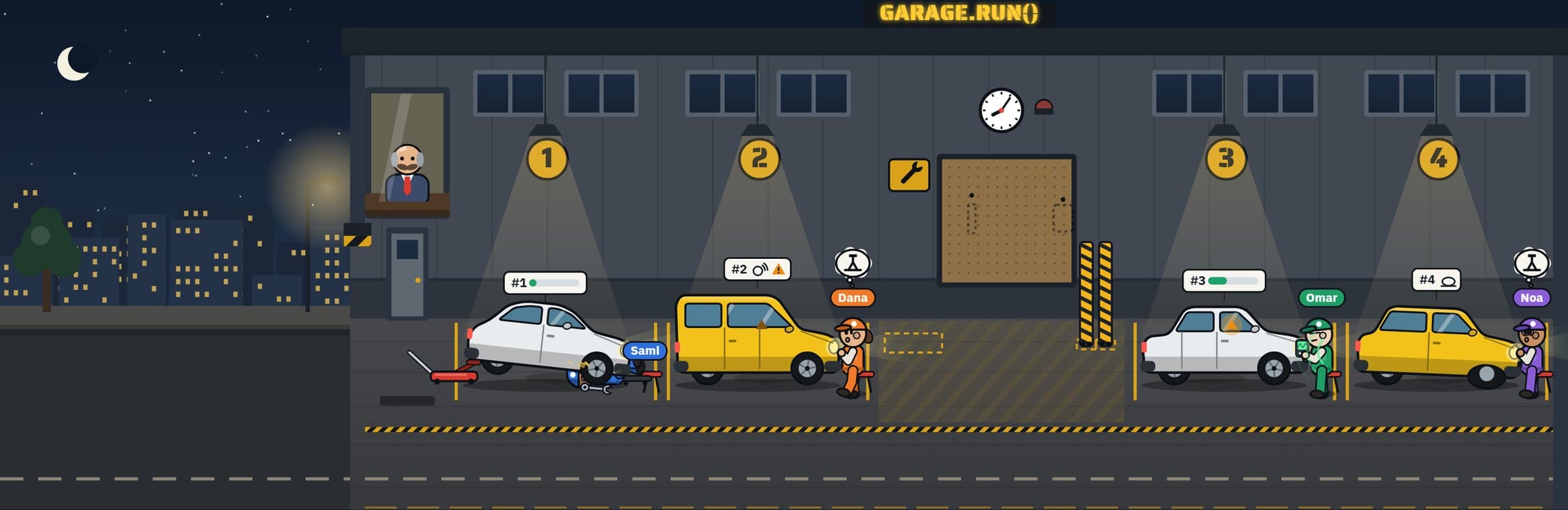
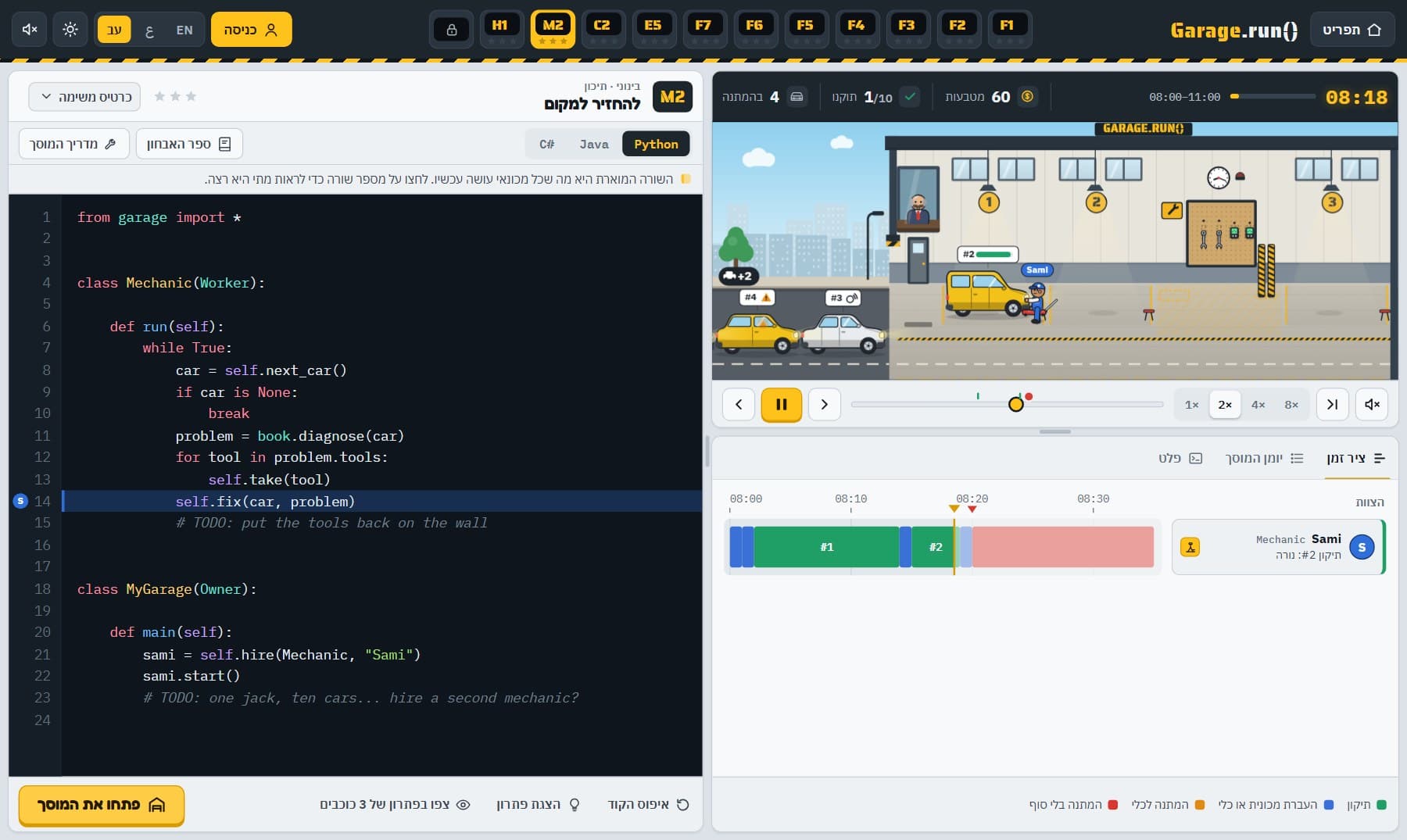
Garage.run() is a coding game in the browser. You write Python for each mechanic, open the shop and watch the shift: cars drive in, mechanics fetch tools from the wall, and sometimes everything freezes in a deadlock. Real concurrent systems behave like this; here you can see it.
Real code
Python (MiniPy, a subset of the language), not blocks. The same language the majors teach.
Concurrency you can see
Threads, locks, semaphores, race conditions, producer–consumer. Every bug shows up in the shop and on the timeline, and the line each mechanic is running lights up in the editor.
A score you can't guess
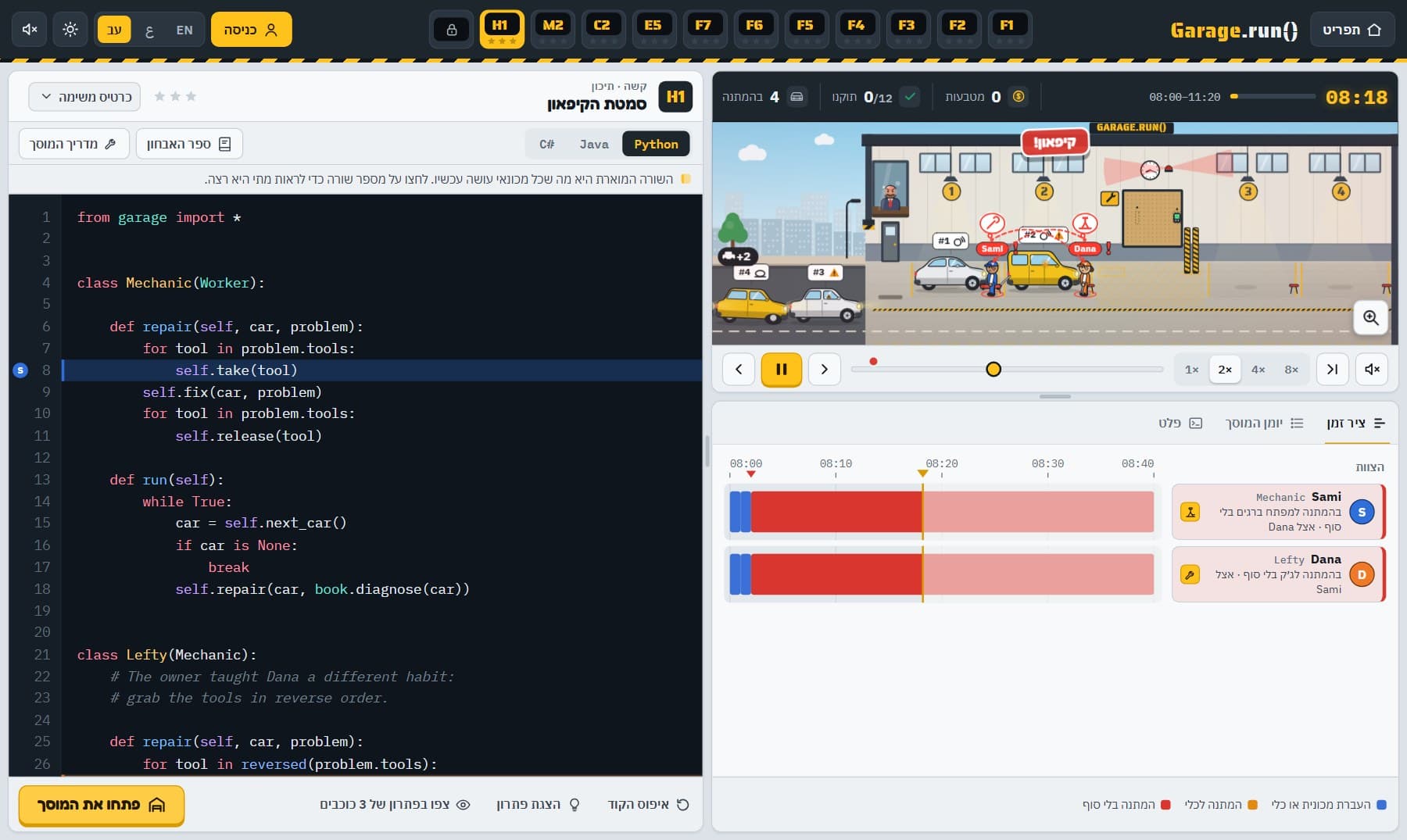
Efficiency 0–100: accuracy 45%, speed 30%, cost 15%, safety 10%. Up to three stars per job.
Three languages
The game and every document in Hebrew, Arabic and English, at the same level. No install, any browser.
What the shop teaches
- variables
- print()
- for loops
- if / elif
- def / return
- lists
- classes
- threads
- locks
- deadlock
- semaphores
- race conditions
- producer–consumer
Open to everyone: 19 jobs
- F1–F7
First steps
No classes yet: variables, print(), for loops, if/elif, functions and lists
- E5 · C2
Classes
Logic gates in the diagnose book, then methods, __init__ and an object's own data
- M2 · H1
Concurrency
Threads, start(), locks, try/finally, deadlock and semaphores
- +8
Practice jobs
One extra job per lesson. Some need Sami to say, or the program to print, exact words.
Five more jobs for signed-in players: producer–consumer, priority scheduling, race conditions, and "Rush hour" with four planted bugs.
One day, three hours, a level nobody has seen
An academic campus with an auditorium and two computer labs. Students compete, teachers have their own professional track, and everyone ends at the ceremony in front of the scoreboard.
- 08:30–09:30
Arrival and check-in
Check-in with the team ID; the accompanying teacher confirms the team. Phones into numbered bags, badges, shirts and breakfast.
- 09:30–10:00
Opening
The host campus, sponsors and partner organisations.
- 10:00–10:30
Briefing and warm-up
The rules from the head judge, and a 20-minute warm-up on a public practice level, on the same machines.
- 10:30
T=0: the secret level opens
Three stages, A, B and C, getting harder. Built only from mechanics in the game, and unseen by anyone before.
- 10:30–13:30
Three hours of contest
Unlimited submissions; the best one per stage counts. A live scoreboard on the big screen, frozen at 12:45.
- 10:45–13:00
Teachers' track
An industry talk, a "teaching concurrency with Garage.run()" workshop, and Q&A.
- 13:30–14:15
Lunch and appeals
Phones come back. Judges re-run the final code on the hidden variants; written appeals 13:45–14:10.
- 14:15–15:30
The ceremony
The level designer walks through the solution, the board is revealed bottom-up, a plaque and certificates for every school, and the top three.
Hold date: 17 Mar 2027. The date falls after the winter bagrut session and the Eid al-Fitr break, and before Purim and Passover.
One team per school
High schools with a computer science, software engineering, cyber or AI major, Jewish and Arab sector, every network.
3 contestants
Students in grades 10–12 of the same school, working together on one team laptop.
One reserve
The school picks and swaps its contestants itself. We never keep their names.
An accompanying teacher
Teachers don't enter the contest hall; they join the teachers' track. A second escort is optional.
A delegation of up to 6
Three contestants, a reserve, the accompanying teacher and an optional second escort. Shirts and badges for everyone.
The server judges. No luck, no draws.
The browser's own result never counts. The organisers' server re-runs every submission in a deterministic engine, on the public stage and on three hidden variants: same rules, cars arriving differently. Code tuned to one stage won't pass.
How stars are earned
- ★ Every car fixed correctly.
- ★★ And no deadlock or crash.
- ★★★ And efficiency of 95 or more.
A stage's stars are the lowest count across its variants; its efficiency is their average. Par is set from the organisers' best solution.
Ranking order
- Total stars (max 9)
- Total efficiency (max 300)
- Lower total simulated finish time
- Lower total wages
- Earlier timestamp of the submission that reached the final score
No AI. Really none.
One laptop, a closed network
One laptop per team, running a locked contest browser on an offline network with no internet. DevTools are blocked.
Devices in a bag
Phones, smartwatches, earbuds and smart glasses go into numbered, sealed bags until lunch.
Any AI is forbidden
ChatGPT, Gemini, Claude, Copilot and every other tool. Penalty: team disqualification and a notice to the principal.
Written clarifications, for all
Questions are answered in writing to every team at once. Afterwards: a code-similarity check against the seat plan.
Much more than a contest day
The package starts on registration day and ends with the results, the stream recording, event photos and a code report you can bring to class.
8 weeks of training for the whole class
Access to the public levels, a training booklet and the "supported Python" sheet.
2 online teacher workshops
In January and early February 2027.
2 live practice rounds
16 Feb and 2 Mar, 60 minutes in your own lab, with a practice level and scoreboard. Practice only, not scored.
Contest day
The secret level, judging, a live stage show with an MC, a live scoreboard, a live stream, and kosher vegetarian meals.
Team kit
Shirts for the delegation (up to 6), badges and a table sign.
A detailed code report
Stars and efficiency per stage and variant, where points were lost, and a sample solution after the contest.
Results and media
The stream recording, a selection of event photos, the results and a press release for the school website, by 18 Mar 2027.
Teachers' track and certificates
A professional track on the day, and certificates the school fills in with its students' names.
Every school leaves with a prize
Prizes are funded from the entry fees. They go to the school, not to individual students.
1st place
The Cup trophy, gold medals, and a free "Garage League" hackathon day at the school in 2027–28.
2nd place
A trophy, silver medals and a free half-day "Garage League" at the school.
3rd place
A trophy, bronze medals and a free live two-hour workshop for the class.
Every school
A trilingual participation plaque, certificates for the students and the teacher (the school fills in the names), and a one-year Garage.run() classroom licence for 2027–28.
Special awards
- Breakthrough · The first team to earn 3 stars on stage A.
- Safe code · No deadlock and no crash across all submissions.
- Debut award · The best-ranked school taking part for the first time.
- City Champion · The best school of each municipality that joins with a bundle.
One price per school, everything included
The price is per team, which means per school. Parents are never charged.
Early registration
₪3,068
Until
Base priceRegular registration
₪3,540
Until
Late registration
₪3,894
Until
City or network bundle
10% off for 5–9 schools and 15% from 10 schools, on the regular price, on one invoice to the owner. Does not stack with the early price.
Payment
Purchase order or invoice, by 21 Feb 2027. Public bodies: net 30. A laptop from us, for a school that needs one: a separate fee per laptop.
Scholarship places
Sponsors can fund the entry of a periphery, Arab-sector or all-girls team.
Cancellation
Full refund until 14 Feb 2027; 50% or full credit until 2 Mar 2027; after that, credit toward next year. In a security situation: postponement or a remote final, with full credit or refund.
The timeline
All dates are in the 2026–27 school year.
- Registration opens
- Early price ends
- Regular registration closes
- Late registration closes
- Live practice round #1 (online, 60 min)
- Payment or purchase order due
- Accessibility requests
- Final headcount and live practice round #2
- Contest day
- Results, stream recording and code report to every school
A tool for class, not just a big day
The Cup complements the curriculum; it doesn't replace it or the Ministry's own contests. The game runs in the browser, with no install, on any school computer.
Concurrency without a whiteboard
Threads, locks and deadlock you can see on screen, with a timeline for every mechanic.
Structured preparation
Two online workshops before the contest, and two live practice rounds run in your own lab.
A code report for the lesson
After the contest: where the team lost points, and a sample solution to discuss in class.
Want to be part of the Cup?
Sponsors fund equipment grants for the top schools’ labs, scholarship places for periphery, Arab-sector and all-girls teams, buses, and production upgrades.
Questions schools ask
Who can take part?
High schools in Israel, grades 10–12, Jewish and Arab sector, every network. The Cup is aimed at computer science, software engineering, cyber and AI majors, and beginners start with the First steps jobs. Each school sends one team: 3 contestants, a reserve and an accompanying teacher.
When is the contest, and when does registration open?
The contest is on Tue 16 Mar 2027, 08:30–15:30 (reserve day 17 Mar 2027). Registration opens on 22 Nov 2026: the early price runs until 15 Dec 2026, regular registration until 31 Jan 2027 and late registration until 14 Feb 2027.
How much does it cost?
₪3,068 per school with early registration, ₪3,540 regular and ₪3,894 late. The price covers the 8 weeks of training, the teacher workshops, the live practice rounds, contest day and the code report. Municipalities and networks get 10% off for 5–9 schools and 15% from 10 schools, on the regular price. Parents are never charged.
How do schools register?
Official registration opens on 22 Nov 2026. You can already leave your details in the pre-registration form at the bottom of this page, and we will send the call for schools, the registration form and the early-price terms. A school registers with its institution code and the school's email only.
Can students practise for free?
Yes. The public levels of Garage.run() are open to everyone in the browser, with no install and no account: 19 jobs, from First steps to concurrency. Registered schools also get 8 weeks of training for the whole class, a training booklet, two online teacher workshops and two live practice rounds.
Can teams use AI during the contest?
No. Every AI tool is forbidden, and so is the internet. The contest runs on a closed network, in a locked browser. A breach disqualifies the team.
Which programming language?
Python only (MiniPy, a subset of Python). The "supported Python" sheet lists what works. The game also shows Java and C#, but only as a preview.
Do students need prior experience?
What the major teaches is enough, and beginners start with First steps: seven short jobs with no classes. The eight weeks of training, the workshops and the two live practice rounds prepare the team for the kind of problems.
Can we send two teams?
No. One team per school: three contestants and a reserve. That way more schools take part.
Do we bring computers?
Yes: each team brings one laptop. A school that needs one can get a laptop from us, for a separate fee per laptop. Apart from the laptop, no personal devices or papers go into the hall; every team gets a printed booklet.
Who pays?
The school or its owner (municipality, network or non-profit), by purchase order or invoice. Parents are never charged.
What data do you collect about students?
None. The school registers with its institution code and the school's email, and gets a team ID from our system to sign in to the practice rounds and the contest. We keep no names, ID numbers or other details of students; the list of participants and the consent forms stay with the school.
Is the event filmed?
Yes, subject to the Ministry of Education's approval. The contest day is filmed and streamed; we publish the material, and the Ministry, local authorities, partners and media may use it too. The school signs a filming and publication acknowledgment and collects the parents' consent, which stays at the school. A student without consent competes as usual, wears a marked lanyard and is not filmed close up. Captions name only the school and town.
What happens in a security situation?
If Home Front Command guidance doesn't allow the day to go ahead, we postpone it or hold a remote final, with full credit or refund.
What about accessibility?
The venue is accessible. The contest runs in a regular full-screen browser, so the laptop's own accessibility settings work, and an accessible workstation is available on request. Accessibility requests by 23 Feb 2027.
Where will it take place?
At an academic campus with an auditorium and two computer labs. The venue will be announced once it is confirmed.
Hold a place for your school
Official registration opens on 22 Nov 2026. Leave your details and we will send you the call for schools and local authorities, the registration form, the filming acknowledgment and the early-price terms.
- One team per school
- Early price until 15 Dec 2026
- Municipalities, networks and sponsors are welcome to get in touch too
- No data about students is collected
Or write to us directly: mohammad@mryosef.com